Starting a business in Africa in 2026 is no longer a speculative move—it’s a strategic one. With fast-growing consumer markets, improving infrastructure, expanding digital adoption, and governments actively courting investment, Africa offers founders and investors real opportunities for scalable growth.
But Africa is not a single market. Each country presents a different mix of regulation, access to capital, talent availability, ease of doing business, market size, and political stability. Choosing the right country can significantly reduce friction and accelerate growth, while choosing poorly can stall even the strongest idea.
This guide ranks the best countries in Africa to start a business in 2026, based on real-world founder considerations, investor preferences, and long-term scalability—not hype.
How We Ranked the Countries
Each country on this list was evaluated using a weighted scoring model built around factors founders and investors care about most:
- Ease of Doing Business & Regulation – Business registration, licensing, taxation, and compliance
- Market Size & Purchasing Power – Population, urbanization, and consumer spending
- Access to Capital – VC activity, banking infrastructure, government incentives
- Talent Availability – Skilled workforce, labor costs, education
- Digital & Physical Infrastructure – Internet penetration, logistics, power, transport
- Political & Economic Stability – Policy consistency, currency risk, security
- Startup Ecosystem Strength – Accelerators, incubators, exits, founder density
The result is a founder-first, execution-focused ranking for 2026.
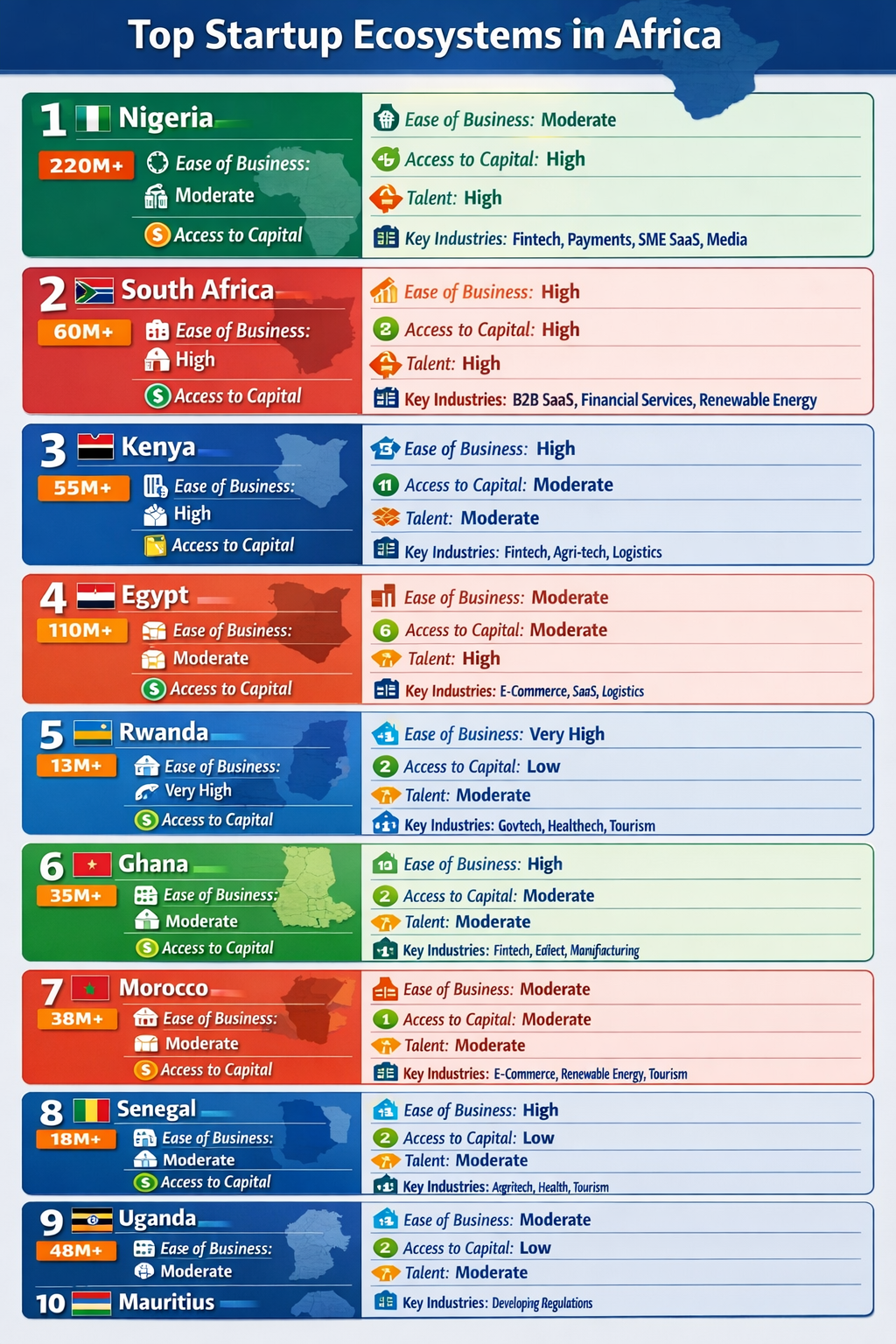
Top Countries in Africa to Start a Business (2026)
1. Nigeria
Why Nigeria Ranks #1 in 2026
Nigeria remains Africa’s most compelling place to start a business in 2026—not because it is the easiest market, but because it offers the largest upside. With over 220 million people, a young population, and Africa’s biggest digital economy, Nigeria rewards founders who can execute well and adapt quickly.
Despite regulatory complexity and infrastructure gaps, Nigeria continues to produce Africa’s most valuable startups and the highest deal volume on the continent. If your business depends on scale, payments, fintech, commerce, media, or consumer demand, Nigeria is difficult to ignore.
- Population: 220M+
- Major Cities: Lagos, Abuja, Port Harcourt
- Business Registration: 1–3 weeks (online via CAC, varies in practice)
- Foreign Ownership: 100% allowed in most sectors
- Currency: Naira (FX volatility remains a key risk)
Nigeria is not a “plug-and-play” market — but no other African country combines scale, digital adoption, and deal flow at this level.
Why Founders Choose Nigeria
Founders choose Nigeria for one reason: scale.
Nigeria produces Africa’s biggest startups because it offers:
- Immediate access to millions of consumers and SMEs
- High demand for digital solutions across payments, commerce, logistics, and services
- A culture of rapid adoption when a product solves real pain points
If a product works in Nigeria, it often works anywhere else in Africa.
Business Models That Perform Best
Nigeria favors execution-heavy, demand-driven models:
- Fintech & Payments: Consumer payments, B2B payments, lending infrastructure
- SME-Focused SaaS: Accounting, payroll, CRM, compliance tools
- Commerce & Logistics: Marketplaces, fulfillment, last‑mile delivery
- Media & Creator Economy: Digital media, influencer-led commerce
- Edtech & Healthtech: Payments-enabled education and diagnostics
Luxury, niche, or slow-adoption products typically struggle unless heavily localized.
Cost of Doing Business
- Talent: Competitive globally; senior talent costs rising in Lagos
- Office Space: Flexible but expensive in prime locations
- Power & Internet: Often self-provisioned (generators, multiple ISPs)
- Taxes: Corporate tax applies; compliance can be burdensome
Nigeria rewards capital efficiency and local partnerships.
Capital, Banking & FX Reality
Nigeria attracts more venture capital than any other African country, but:
- Opening and operating bank accounts can be slow
- FX repatriation and currency risk require planning
- Dollar-denominated revenue or exports offer protection
Local banks are strong, but fintech rails often outperform traditional systems.
Real Downsides (No Sugarcoating)
- Policy inconsistency and sudden regulatory shifts
- Power and logistics challenges increase operating costs
- Currency devaluation risk impacts pricing and margins
Nigeria punishes poor execution faster than most markets.
Who Should NOT Start in Nigeria
- Founders seeking regulatory simplicity
- Businesses dependent on stable FX or fixed margins
- Teams without local knowledge or partners
Founder Verdict
Nigeria is Africa’s hardest major market — and its most rewarding.
If you can build for Nigeria, you build with resilience, speed, and scale baked in. Few markets offer the same upside in 2026.
2. South Africa
Business Snapshot (2026)
South Africa is Africa’s most institutionally mature economy, offering strong legal frameworks, deep capital markets, and advanced financial infrastructure.
- Population: 60M+
- Major Cities: Johannesburg, Cape Town, Durban
- Business Registration: 1–2 weeks (CIPC)
- Foreign Ownership: Fully allowed in most sectors
- Currency: Rand (volatile but liquid)
Why Founders Choose South Africa
South Africa appeals to founders who value structure over speed. Contracts are enforceable, financial systems are reliable, and corporate governance is well understood.
Business Models That Perform Best
- B2B SaaS & Enterprise Software
- Financial Services & Insurtech
- Manufacturing & Industrial Services
- Renewable Energy & Climate Tech
Cost of Doing Business
- Talent: Skilled but expensive relative to Africa
- Infrastructure: Strong by regional standards
- Taxes: Higher compliance burden, predictable enforcement
Capital, Banking & FX Reality
South Africa has Africa’s deepest banking and capital markets. Venture capital exists, but enterprise sales cycles are longer.
Real Downsides
- Slower economic growth
- Rigid labor laws
Founder Verdict
Best for companies prioritizing compliance, enterprise clients, and regional headquarters.
3. Kenya
Business Snapshot (2026)
Kenya remains East Africa’s innovation hub, anchored by Nairobi’s strong fintech and mobile economy.
- Population: 55M+
- Major Cities: Nairobi, Mombasa
- Business Registration: 1–2 weeks
- Foreign Ownership: Generally allowed
- Currency: Kenyan Shilling
Why Founders Choose Kenya
Kenya offers a balance of innovation, regional access, and mobile-first consumer behavior.
Business Models That Perform Best
- Fintech & Digital Credit
- Agri-tech
- Logistics & Trade Platforms
- Climate & Energy Tech
Cost of Doing Business
- Talent: Mid-range costs
- Infrastructure: Strong digital, moderate logistics
Capital & Ecosystem
Strong presence of accelerators, DFIs, and early-stage capital.
Real Downsides
- Increasing taxes
- Rising urban costs
Founder Verdict
Best for mobile-first startups targeting East Africa.
4. Egypt
Business Snapshot (2026)
Egypt combines scale with technical depth, serving as North Africa’s largest startup market.
- Population: 110M+
- Major Cities: Cairo, Alexandria
- Business Registration: Improving, still bureaucratic
- Foreign Ownership: Allowed
- Currency: Egyptian Pound (devaluation risk)
Why Founders Choose Egypt
Large domestic demand, strong engineering talent, and access to MENA markets.
Business Models That Perform Best
- E-commerce
- Fintech & Payments
- Logistics & Mobility
- SaaS for Arabic-speaking markets
Cost of Doing Business
- Talent: Cost-effective technical workforce
- Operations: Affordable compared to Gulf markets
Capital & Banking
Growing VC activity with strong government-backed initiatives.
Real Downsides
- Currency instability
- Bureaucracy
Founder Verdict
Best for founders targeting North Africa and MENA scale.
5. Rwanda
Why It Ranks High Rwanda punches above its weight with pro-business policies, fast company registration, and strong government support.
Best Industries (2026)
- Govtech
- Healthtech
- Logistics
- Tourism & Services
Watch Outs
- Small domestic market
Best For Startups needing speed, regulatory ease, and pilot-friendly environments. *
6. Ghana
Why It Ranks High Ghana offers political stability, strong English-speaking talent, and improving startup infrastructure.
Best Industries (2026)
- Fintech
- Edtech
- Digital Media
- Light Manufacturing
Watch Outs
- Smaller capital market than Nigeria
Best For SMEs, diaspora founders, and service-based startups seeking stability. *
Why It Ranks High
Morocco has emerged as a gateway to both North Africa and Europe, combining political stability with strategic trade agreements, growing urban markets, and a rapidly improving digital ecosystem. Casablanca and Rabat are hubs for finance, logistics, and tech innovation.
Best Industries (2026)
-
E-commerce & Marketplaces
-
Fintech & Digital Payments
-
Renewable Energy & Cleantech
-
Tourism & Hospitality Tech
Watch Outs
-
Bureaucratic hurdles in certain sectors
-
Smaller venture capital ecosystem compared to Egypt or Nigeria
Best For
Startups targeting cross-border trade, MENA expansion, or export-oriented businesses.
-
Senegal
Why It Ranks High
Senegal is West Africa’s stable, francophone business hub, with government support for entrepreneurship and growing digital adoption. Dakar is a vibrant hub for startups, offering a testbed for francophone West Africa.
Best Industries (2026)
-
Agritech & Food Supply Chains
-
Fintech & Mobile Payments
-
Tourism & Cultural Services
-
Healthtech
Watch Outs
-
Limited domestic market scale
-
Smaller early-stage funding compared to Nigeria or Kenya
Best For
Startups seeking francophone West Africa expansion, pilot-friendly environments, and government-supported programs.
-
Uganda
Why It Ranks High
Uganda offers a young, tech-savvy population and strong mobile-first adoption, making it an attractive testing ground for digital services and financial solutions. Kampala is the hub for startups and innovation.
Best Industries (2026)
-
Mobile & Digital Finance
-
Agritech
-
Healthtech & Telemedicine
-
E-commerce & Logistics
Watch Outs
-
Limited access to venture capital
-
Regulatory processes still developing
Best For
Startups looking for early-stage traction, social impact ventures, and mobile-first consumer solutions.
-
Mauritius
Why It Ranks High
Mauritius combines ease of doing business with strong financial services infrastructure and favorable tax policies. It’s a prime destination for fintech, B2B services, and regional headquarters serving Africa.
Best Industries (2026)
-
Fintech & Payments
-
B2B SaaS & Enterprise Services
-
Tourism Tech & Hospitality
-
Export-Oriented Manufacturing
Watch Outs
-
Small domestic market
-
High operational costs relative to the region
Best For
Startups seeking regulatory ease, tax efficiency, and regional headquarters for African operations.
| Rank | Country | Population | Ease of Doing Business | Access to Capital | Talent Availability | Key Industries (2026) | Notes / Watch Outs |
|---|---|---|---|---|---|---|---|
| 1 | Nigeria | 220M+ | Moderate (1–3 weeks) | High | High (competitive) | Fintech, Payments, SME SaaS, Commerce, Media | Regulatory complexity, FX volatility, infrastructure gaps |
| 2 | South Africa | 60M+ | High (1–2 weeks) | High | High (expensive) | B2B SaaS, Financial Services, Renewable Energy | Slower growth, rigid labor laws |
| 3 | Kenya | 55M+ | High (1–2 weeks) | Moderate | Moderate | Fintech, Agri-tech, Logistics, Climate Tech | Rising urban costs, increasing taxes |
| 4 | Egypt | 110M+ | Moderate | Moderate | High (cost-effective) | E-commerce, Fintech, Logistics, SaaS | Currency instability, bureaucracy |
| 5 | Rwanda | 13M+ | Very High (1–2 days) | Low | Moderate | Govtech, Healthtech, Logistics, Tourism | Small domestic market |
| 6 | Ghana | 35M+ | High | Moderate | Moderate | Fintech, Edtech, Digital Media, Light Manufacturing | Smaller capital market than Nigeria |
| 7 | Morocco | 38M+ | Moderate | Moderate | Moderate | E-commerce, Fintech, Renewable Energy, Tourism | Bureaucratic hurdles, smaller VC ecosystem |
| 8 | Senegal | 18M+ | High | Low | Moderate | Agritech, Fintech, Tourism, Healthtech | Limited domestic scale, smaller early-stage funding |
| 9 | Uganda | 48M+ | Moderate | Low | Moderate | Mobile Finance, Agritech, Healthtech, E-commerce | Regulatory processes still developing |
| 10 | Mauritius | 1.3M+ | Very High | Moderate | Moderate | Fintech, B2B SaaS, Tourism Tech, Export Manufacturing | Small domestic market, high operational costs |
Final Thoughts
Africa in 2026 is a continent of opportunity—but success is not guaranteed. Scale comes with complexity, and ease comes with smaller markets. Founders must match their business model, risk tolerance, and growth ambitions with the right country.
The top 10 countries in this guide provide a roadmap for founders seeking growth, resilience, and market validation. From Nigeria’s unmatched scale to Rwanda’s regulatory efficiency, each market offers a unique mix of opportunity and challenge.